
Why You Should Avoid KDP Expanded Distribution (And What to Do Instead)

While it sounds great on paper, many experienced indie authors purposely leave this box unchecked. You should avoid KDP Expanded Distribution if any of the following apply to your strategy:
1. You plan to use IngramSpark directly
If you want true global distribution, the standard industry practice is to publish your paperback on Amazon KDP and upload it separately to IngramSpark (the world’s largest book distributor). If you check “Expanded Distribution” on KDP, Amazon takes over those rights, triggering a system conflict that blocks you from uploading the same ISBN to IngramSpark.
2. You want your book physically on bookstore shelves
Physical bookstores will almost never order books through Amazon’s Expanded Distribution. Why? Bookstores operate on a “returnable” model—if a book doesn’t sell, they expect to ship it back for a refund. Amazon’s program does not allow returns. If bookstore shelves are your goal, you must use IngramSpark, where you can manually toggle your book to “Returnable.”
3. You want to maximize your royalties
The financial trade-off for Expanded Distribution is massive. Because third-party retailers expect a heavy wholesale discount, your royalty rate plummets.
| Metric | Amazon Direct Sale | Expanded Distribution Sale |
| Base Royalty Rate | 60% of List Price | 40% of List Price |
| Example ($14.99 Book, $3.25 Print Cost) | $5.74 profit to you | $2.74 profit to you |
Warning: To absorb this 20% royalty cut, Amazon will force you to raise your book’s minimum retail price. Enrolling might price your paperback out of what everyday Amazon readers are willing to pay.
4. You want to avoid third-party “buy box” poaching
A strange side effect of Expanded Distribution is that third-party sellers will use the wholesale network to buy copies of your book, list them on Amazon’s own platform for a few cents cheaper than your retail price, and steal your “Buy Box.” When a customer buys from them, you only get the low 40% wholesale royalty instead of your full 60% royalty.
What genre is your book, and do you have a specific marketing goal to get into local bookstores, or are you primarily focused on driving online sales?
The Correct Workflow (The “Double Upload”) Ingram and KDP
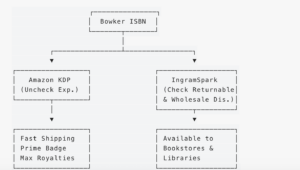
To protect your online sales and get into bookstores, you use your Bowker ISBN on both platforms at the same time. Here is the exact order of operations:
- Buy your ISBN from Bowker. (Keep the exact same title, author name, and format details ready.
Upload to Amazon KDP first (or simultaneously). Input your Bowker ISBN. Proceed to the pricing page and leave the “Expanded Distribution” box unchecked. Publish it.
Upload to IngramSpark. Input that exact same Bowker ISBN and upload the exact same manuscript and cover files. On Ingram’s distribution settings, select their global distribution.
How Amazon Handles the Clash
Because Amazon sees the exact same ISBN on KDP (their internal printer) and IngramSpark (the external wholesaler), Amazon’s system is smart. It will override the Ingram feed for its own website.
This means Amazon will print and ship your book instantly via KDP (with Prime shipping and maximum royalties), while the rest of the world (Barnes & Noble, local indie stores, libraries) will order your book through the Ingram network.
Have you already formatted your book layout and cover file, or are you still in the editing phase before you purchase that Bowker ISBN?