
The Day Seth Godin Blew Up Publishing . . . and I Was in the Room
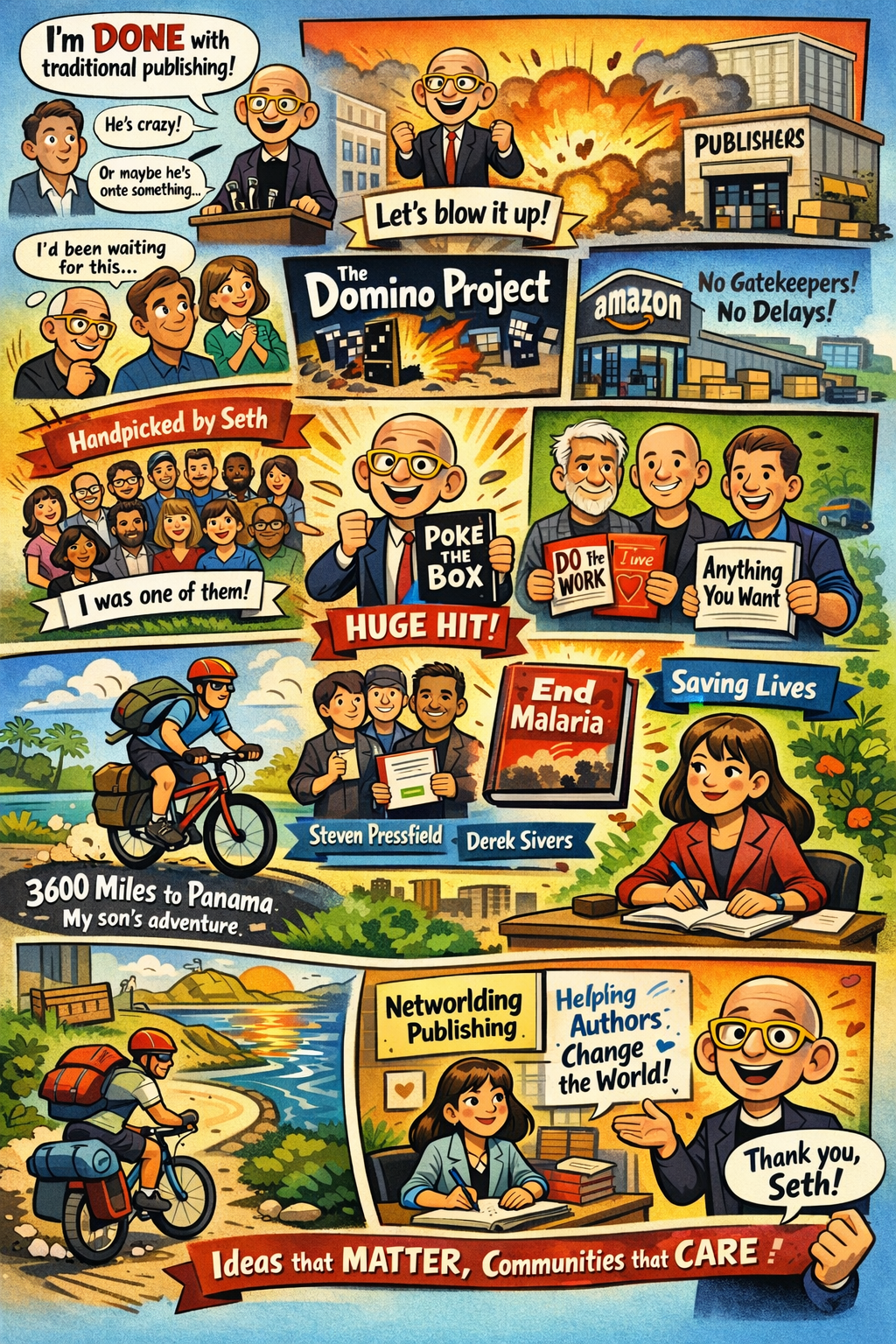
In 2010, Seth Godin, who’d written twelve bestsellers translated into more than thirty languages, made an announcement that sent shockwaves through the publishing industry. He was done with traditional publishing. Finished. Walking away from the system that had made him famous.
Most people thought he was crazy.
I thought he was finally saying what I’d been thinking for years.
Seth had a simple but radical observation. A blog post could reach a million people in a day. A book, arguably a far more powerful vehicle for ideas, took twelve to eighteen months just to get through the editorial and production pipeline. By the time it hit shelves, the conversation had often moved on. The system meant to spread great ideas was actually slowing them down.
So he decided to blow it up.
He called the experiment The Domino Project, not named after the game but after the domino effect. One powerful idea tips into the next person, who tips into the next, until something unstoppable builds. He partnered directly with Amazon, bypassing every traditional middleman, the agents, the distributors, the bookstore buyers, to create something nobody in publishing had attempted at that scale. Amazon agreed to power the entire back end: printing, distribution, and digital delivery. No traditional publisher involved. No twelve-month timelines. No playing it safe.
And then Seth did something that changed my career.
He handpicked seventy people to help him figure it all out.
I was one of them.
At that point, I’d already published ten books across six traditional publishers. Five of them were bestsellers. One was featured on Oprah. Another hit #5 on the Wall Street Journal list. My seventh book, “Networlding,” held a #10 spot on Amazon across all categories for an entire year. I’d been on the Today Show and other major national broadcasts. I knew publishing inside and out — how it worked and how it was failing.
But being inside Seth’s experiment was something else entirely.
The Domino Project launched in March 2011 with Seth’s own book, “Poke the Box,” a short, punchy manifesto about initiative. Not a 300-page business book. A manifesto. That was the point. Seth believed the future of books wasn’t about length or literary prestige. It was about spreading ideas that demanded to be passed from hand to hand. He wanted books you’d buy in five-packs and give to your team. Books you’d finish in an afternoon and text your best friend about. Books that made you do something, not just think something.
“Poke the Box” sold more copies in its first month than any book Seth had ever published.
Over the next year, the project released work by thinkers I deeply admired: Steven Pressfield’s “Do the Work” and Derek Sivers’s “Anything You Want.” Each one was lean, potent, and designed to travel fast.
And then came the project that still gives me chills.
Seth and author Michael Bungay Stanier assembled sixty-two of the most respected business minds in the world — Tom Peters, Brené Brown, Sir Ken Robinson, David Allen, Daniel Pink, Gary Vaynerchuk, Dave Ramsey, and Keith Ferrazzi, and asked each to contribute an essay to a single book. It was called “End Malaria.” Amazon agreed to forgo any profit. The contributors donated their work. Twenty dollars from every copy went directly to Malaria No More to purchase mosquito nets for children in Africa.
No one made a dime from that book. Every dollar saved a life. With this project, I was able to share the amazing ride my son took: 3600 miles on his bike, first down to Florida, traveling even on major highways every day for six weeks, to Panama, before he returned by plane to Chicago. He had beaten cancer, and this was his celebration.
That was the moment I understood what Seth was really teaching us. Publishing isn’t about selling books. It’s about spreading ideas that matter — and building communities of people who care enough to pass them along. The Domino Project wasn’t just a new distribution model. It was a proof of concept for something much bigger: that when you organize a book around a mission rather than a margin, people show up in ways the traditional system never imagined.
I brought everything I learned back into my own work.
In 2010, I’d already founded Networlding Publishing to help thought leaders write, publish, and launch books that made a real impact. But Seth’s experiment sharpened my thinking in ways I didn’t expect. It confirmed what I’d been building toward: the old model of writing a book, handing it to a publisher, and hoping for the best was not just outdated. It was a disservice to the ideas and the people behind them.
Since then, I’ve helped more than 170 thought leaders bring their books to life. Chief Digital Officers. Heads of diversity at global firms. Seven-time Inc. 500 entrepreneurs. Bestselling authors with millions of copies sold. Each one came to me with an idea that mattered, and together, we turned it into something people couldn’t stop talking about.
That’s what being chosen by Seth Godin taught me. Not just what the future of publishing looks like, but what it feels like when you stop waiting for permission and start building it yourself.