
Short Books: 5 Steps to Writing a Book Under 100 Pages That People Actually Read, Finish, and Share
The publishing industry rarely talks about a surprising fact: three of the best-selling books in the top 100 of all time are under 100 pages. That accounts for three percent of the entire list. Even more impressive is that readers quote, gift, and remember those three books (The Little Prince, Jonathan Livingston Seagull, and Who Moved My Cheese?) far more often than most 300-page volumes.
To look at the numbers, The Little Prince still sells 2.5 million copies a year. This tiny volume spans only 96 pages, yet translators have brought it into more than 300 languages. No one ever finishes that book and wishes it had been longer.
The Power of the Single Idea
I have been publishing books for 36 years. During that time, I have guided more than 175 thought leaders through the writing process. This experience taught me one vital lesson: a short book with one powerful idea will outperform a long book with seven half-developed ideas every single time.
I learned this lesson firsthand in 2011. Seth Godin launched the Domino Project, a publishing experiment that released 12 books in one year. All were under 100 pages, and all became bestsellers. To help those books reach readers, Seth assembled a “street team” of 70 people from around the world. These individuals understood that the future of ideas was not about bookstore shelf space. Instead, it was about trust, community, and the willingness to put a book directly into someone’s hands. Seth chose me as one of those 70.
Lessons from the Street Team
Being part of that street team was not a passive role. We were there because we believed what Seth believed: a short, well-crafted book placed into the right hands at the right moment can change a person’s thinking faster than anything else in publishing.
We watched it happen in real time. General Electric sponsored Steven Pressfield’s Do the Work and gave it away for free. Meanwhile, Julien Smith’s The Flinch hit 100,000 downloads before most people even knew it existed. These books spread because authors designed them to spread, and because people like us were out there putting them into circulation.
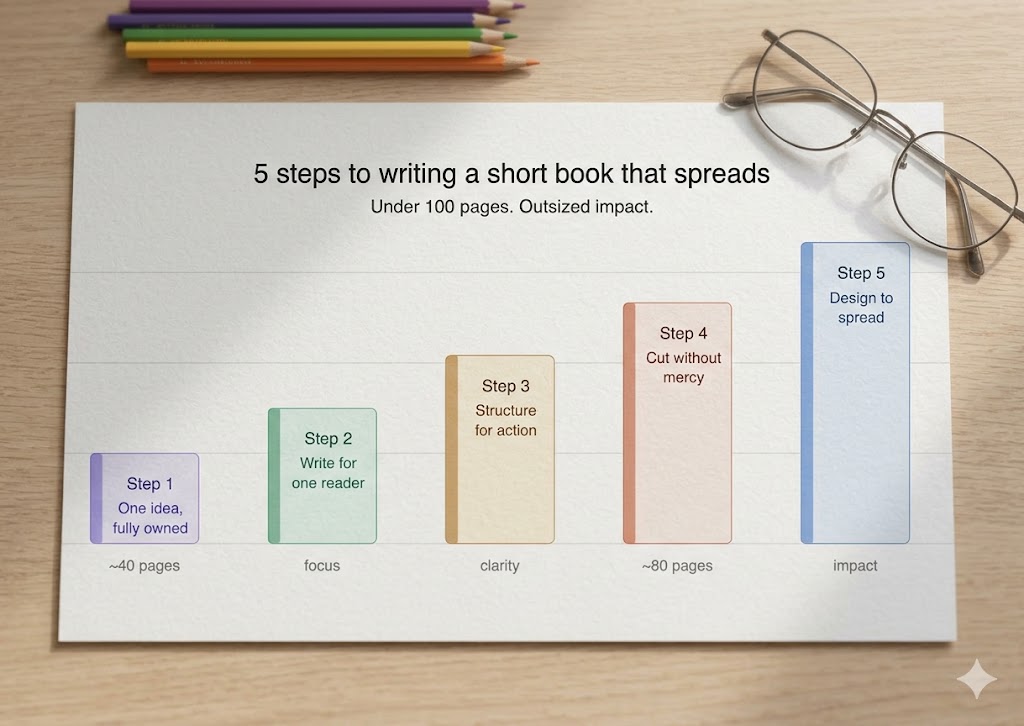
That experience reshaped how I think about what a book should do. Here are the five steps I took away from it.
Step 1: Claim one idea and own it completely
The biggest mistake I see thought leaders make is trying to put everything they know into one book. They have spent 20 years building expertise, so they feel the pressure to prove it. This results in a book that says too much and lands nothing.
A short book forces a choice. What is the one idea you want a reader to walk away with? Not five ideas. Just one.
Think about the classics. The Dip is about knowing when to quit. Who Moved My Cheese? focuses on adapting to change. Jonathan Livingston Seagull stays locked on the relentless pursuit of excellence. Each of those books could have easily been padded to 250 pages, but the authors chose restraint. That restraint is exactly why they spread.
Before you write a single chapter, finish this sentence: “This book is for [specific person] who wants [specific transformation].” If you cannot finish it cleanly, you have a topic rather than a book. Keep narrowing until you have a book.
Step 2: Write for one reader, not a crowd
When you try to write for everyone, you write for no one. Short books work because they feel personal. The reader picks one up and thinks, “This was written for me.”
Being part of Seth’s street team showed me this. The books we were sharing did not feel like products; they felt like letters. Each one was so precisely aimed at a particular person with a particular problem that handing one over felt like a gift you had been saving for the right moment.
I call this finding your “one reader.” To do this, write a paragraph describing the exact person who needs this book. What keeps them up at night? What have they tried that has not worked? Consider what their life would look like if your idea actually landed. Write every word with that person in front of you.
Step 3: Structure for action, not comprehension
Most authors structure books to inform, but the best short books structure for movement.
There is a real difference here. A book structured to inform gives readers information and lets them decide what to do. On the other hand, a book structured for action gives readers information and then tells them exactly what to do next.
My framework for this is simple. Every chapter should answer three questions:
What is true?
Why does it matter?
What do you do about it today?
That third question is the one most authors skip. They build the case beautifully and then leave the reader nodding along with no clear next step. Short books cannot afford that. Every chapter should push the reader toward action. This is what makes them want to share the book; they want someone else to take the same step they just took.
Step 4: Cut without mercy
This is where most authors struggle. It is the point where the book either stays short or quietly grows back to 250 pages.
Here is the test I use with every author I coach: read each paragraph and ask, “Does this advance the reader toward the transformation I promised, or does it just prove I know a lot?” If it is the latter, it goes.
This means your best story goes if it does not serve the idea. The research you love but the reader does not need goes. Even the chapter you wrote to impress peers in your field must go. Short books are not about impressing; they are about changing something for the reader. When you finish cutting and the manuscript makes you a little nervous because it feels lean, you are likely exactly where you need to be.
Step 5: Design the book to spread
This is the step I learned most directly from the Domino Project. Seth did not just write short books; he engineered them for movement. He sold five-packs and 52-packs of Poke the Box so organizations could hand them to entire teams. He ensured Do the Work was sponsored so it could travel for free. He was thinking about the reader’s colleague, boss, and friend.
As part of the street team, that was our job. We were the first link in the chain. We put the books into the hands of people who would put them into more hands. It worked because the books were built to be passed along.
Ask yourself before you publish: “Who will this reader give this book to, and why?” If you cannot answer that question clearly, the book is not spreadable yet. A spreadable book solves a problem the reader knows other people also have. It is short enough to finish in one sitting and generous enough to give away before the week is out.
Final Thoughts
Your marketing strategy for a short book is not an ad campaign. It is the book itself. The world does not need another long book that makes its point in the first 80 pages and then spends the next 200 trying to justify its own existence.
The world needs your best idea, delivered cleanly, at exactly the length it deserves. Write that book.
Reach out and let’s have a real conversation, no strings attached. Promise
Melissa G. Wilson, founder of Networlding Publishing and author of the upcoming book The 7 Great Exchanges, has guided more than 175 thought leaders in transforming their ideas into powerful books that build authority, influence, and lasting impact.
Hand-selected by Seth Godin in 2011 for the exclusive Domino Project street team, Melissa brings a rare blend of publishing expertise, strategic insight, and deep connection to every author she serves.
If you feel called to become a thought leader or to finally write the book that’s been inside you, Melissa invites you to begin.
Reach out for a complimentary 20-minute conversation to explore your book, your message, and your next level of influence.
📩 melissa@networlding.com