
A Powerful Interview with Author Steve Pemberton
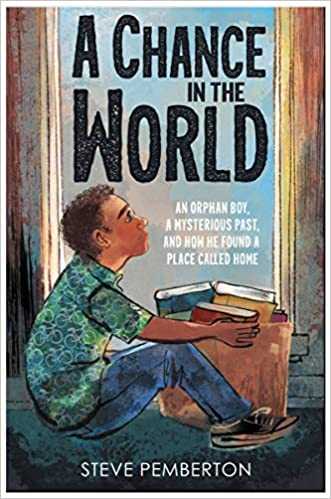
I recently had the honor of interviewing Steve Pemberton, Chief People Officer for Workhuman, the leading online platform bringing positivity to the workplace through social recognition. Prior to assuming his role at Workhuman, Steve was a Senior Human Resources Executive at Walgreens. Below I talk with Steve on the creation of his most recent book, A Chance in the World (Young Readers Edition).
***
MELISSA: The big thing that I want to talk to you about today is the power of the young readers’ edition of A Chance in the World (Young Readers Edition): An Orphan Boy, a Mysterious Past, and How He Found a Place Called Home World How did this book evolve?
STEVE: It evolved in part because of the response and the reaction to the trade version. The book was really a bucket list item for me because my children were asking me about my own family story. I realized because of the repetitiveness of their questions, I should probably get this down. And as I was going through that process, a friend of mine I worked with at Monster.com said, “I really think there’s something else here,” and he wouldn’t let it go. But even then, when it was published and came in the mail, I saw my name on it, I’m like, “That’s pretty cool.
I’m now a published author.” But that’s all it was. I’m a young dad, raising a family, and very busy life. So I’ve done that…moving on. Then all of a sudden, I got bombarded by all of this reaction and response, which I was not anticipating; and from all over the world. The Orphan Story is a universal story. There’s a powerful narrative in England—think Charles Dickens.
MELISSA: That’s what I was thinking. I love Dickens.
STEVE: It’s also a powerful story in Africa, and in India. I learned that pretty quickly. So that in the course of writing my life story, I was writing chapters of other people’s lives. And the other thing that I picked up on was standing in front of long lines of people who wanted me to sign their book, and so the other thing I picked up on is they would have two or three copies with them. So I knew that one of them was for them, but I wondered, “Well, who are the other two for?” And what they were telling me was amazing! “This is for my neighbor who just adopted a child.” “This is for my mother, who was in foster care as a young girl,” “This is for my older sibling who is still dealing with some issues from his childhood.” And in that moment, I realized that 1) A lot of this was around early years. And that I needed to get this story down for a younger audience because that was the common thread of what people were telling me; that these were for, it was for the young people in their life, or it was for a younger version of themselves.
That set my sail right towards that young reader version.
MELISSA: That is amazing! Have you told other interviewers that? Is that something you’ve shared already?
STEVE: Not to that level of detail.
MELISSA: So, the people who were reading your book became a kind of focus group all along the way.
STEVE: That’s exactly what they were. So a lot of the questions at the end of the chapters are really the questions that they asked me.
So there are these moments of reflection. They would say, for example, “Well, how do I navigate difficulty in my family?” and I would say, “Well, what are the three things that you accept about your family, and what are the three things that you appreciate?” So on the one hand, yes, this is an acknowledgment that no family is perfect; no family is that some far-off ideal. That there’s difficulty. But what is it that you appreciate about what you have?
And so it’s intended to make you really reflect: Yes, it’s not perfect, but no family is perfect. But what are the things that I really value about mine?
MELISSA: Yes, and I love that, I think that’s incredibly powerful. What I am hearing from you is that your book opened up a whole new avenue of hearing a need out there, and then you fulfilling that need with this young reader’s edition and then going beyond that now into your new book that will come out in the fall called The Lighthouse Effect. I love the title by the way. I think it’s fantastic. But what was your emotional journey as a result of the first book?
STEVE: Thank you. It was an emotional journey. There are two ways I would describe it.. I would tell you that I never entered into it, nor did I need to write it as a cathartic exercise. Now, it doesn’t mean that you don’t have to be healed from something like that, because I think that you do. But for me the healing was to be found in becoming a husband and father, that was the healing element for me. So as a result, it kind of freed me up to write about the joy or the triumph, and not the tragedy. In fact, the subtitle to me is probably more important—Mysterious Past, How He Found a Place Called Home. Because that is what the real story is, about the things that I inherited. So I do think that you have to be healed, but it doesn’t necessarily have to come from writing.
I will tell you, though, it did have an effect on me that was not about me. It was actually about my mother and father. What I mean by that is there was a way that I saw them and had seen them. In the 20 years that had elapsed between when I found out who they were and when I wrote the book, there was a certain lens through which I saw them.
But writing the book changed the way that I saw them. I certainly had not fully understood what they had endured in their lives until I wrote the book. And I came to understand how difficult their lives were, how much they were denied, how much they had lost and how ill-equipped they were to handle what they had lost. And so this was an inheritance they had kind of passed along to me. But they had inherited it, too. My mother inherited alcoholism almost certainly from her mother. And likely her father, too.
My Father
I was orphaned, but my father was also orphaned. This was a cycle. And there’s something instructive for all of us, to take a step back and say, “Okay.” How they have shown up in the world was a reflection of their own difficulties, and ironically, it was a conversation with a woman that I met on a train about 10 years ago, as I was writing the book that brought this to my attention. And a mutual friend, he’s walking down the aisle, and I see him, and he sees me, “Hey, Steve! How you doing?” “Joe, how you doing?” and he says, “Well, hey, I’ve got an extra seat at my table, why don’t you come join me?” And he’s with this person who’s running an organization called The Marathon Club.. So we sit down and I meet Carmen.
We’re talking about our families, our spouses and our children, and Joe says, “Listen, I have an upgrade to First Class. You two are getting along so well, I’m going to leave you alone for you two to talk.” And I was like, “Yeah, Joe, that’s a pretty fast one you pulled!” So then Carmen says, “Well, Joe told me you’re writing a book. What’s it about?” And I told her a bit what it’s about, then she asked me a question, speaking of questions – she said, “Have you ever gotten writer’s block?” And I said, “No, I haven’t. But I am writing about a rather universal experience that most people have that I have not had, and that is having parents.” And at one point you try to explain something to someone in your life, you keep at cruising altitude because you don’t want to go down in the weeds…”
And so I said, “I’m trying to write about my mother and father, who I did not know. Does that make any sense?” and she says, “Well, actually it makes a lot of sense because I just met my father for the first time a few years ago.” And from that conversation, what became really clear to me was that she had understood her father’s absence in her life and that it wasn’t necessarily or entirely of his choosing. And boy, that was a lighthouse moment! But she’s a complete stranger. I’d never met her before. But that conversation completely changed the way that I saw my mother and father, and from that point forward.
So that’s why in the book I kind of introduce you to them twice: you get to meet them as I knew them in the first 20 years, but then you meet them a little bit later and you come to understand their loss, and their great hopes, too, that didn’t come to pass. And so that is the emotional journey of healing. Healing isn’t always about your healing. Healing can also be about somebody else’s healing too, and perhaps out of their pathway to healing, or the fact that they never found it. And my mother and father never really found it.
Now, I do think that their spirits are healed, though. My faith tells me that.
MELISSA: That’s beautiful.
STEVE: Because of how my life turned out, they have three wonderful grandchildren.
MELISSA: And what I love about that, being realistic – it’s not a religious book, but it has faith in it,—a spiritual foundation in it.
STEVE: That’s an important distinction.
MELISSA: I’m also seeing now that readers want more than just, “Here’s a hardcore story,” – I don’t know if it’s black and white – it’s interesting.
STEVE: Well, that’s absolutely the intention of The Lighthouse Effect. Is to suggest that there’s a different way to live beyond the polarization and the dissonance and the cynicism that is so pervasive in society. You see it everywhere we turn. You see it in the way we engage and interact on social media, you see it certainly in the world of politics, in the news that we are bombarded with daily, and I think most people are hungering for find, as Tolkien so beautifully said, “The goodness in the land.” And where is that goodness to be found if it’s not on our social media timelines, it’s not in politics, and it’s not – and where is the goodness?
And what I’m suggesting is that goodness is within us— the everyday people. And it’s in the people who drive our children to school, who deliver our mail, and stock our grocery shelves. And if we look down the voyage that is our life, we are reminded of the people who were lighthouses for us. And while you can take inspiration from public figures, a lot of them fall quite short.
Inspiration is more to be found in the lighthouses. Now, the power of the lighthouse as an analogy is so instructive, because the lighthouse as an architectural structure is selfless. It does not ask for compensation, nor can you pay it if you wanted to. And there is a strength and a nobility to the lighthouse, and it exists wherever there is difficulty. So wherever you see a lighthouse, there’s one thing you know for sure – there is danger nearby. It could be an abandoned shipwreck, it could be a reef, it could be a hotspot for storms, but that’s where the lighthouse stands.
There are 22,900 lighthouses in the world. As a technical matter, we don’t really need lighthouses anymore because we have global positioning systems and electronic navigational charts. Even sailors will tell you that other than as a sightline off in the distance, you don’t really need lighthouses. And yet, they still have a hold on our consciousness. And the reason they do is not that we need them to navigate the sea, but because we need to be reminded of how to navigate humanity.
MELISSA: Wow!
STEVE: Because the best attribute of the lighthouse is selflessness. That it turns doubts into destinations, that it sees not circumstances, but possibilities. That it gives what it can. That it illuminates outward. Well, those are the things that we want to embody as human beings. The most powerful lighthouses in the world are the human ones. We’ve all had lighthouses in our lives, all of us have. I’m not referring to people in your family. I’m referring to people you encounter along the way.
MELISSA: Right in your own backyard. It’s not something you have to truck up to a mountaintop. Or go down the highest level of rapids. There’s not this endurance thing to get there. You’ve put it right within arm’s reach if you will. And then if you look you will find – and that biblical concept of, “Once I was blind but now I see” – you’ve brought about this stark level of awareness, that if I go out of my home today and I walk out there, I have every chance of connecting with someone who could be a lighthouse for me, and me for them, too.
You are connected throughout the world with your messages now. What’s planned for how you’re going to deliver? How can people find you?
STEVE: Put a story in the hands of young people—a story can show them a pathway forward. And also a reminder to us as adults of the impact that we can have on a young person’s life. Generally speaking, we’re too young as children to fully articulate the impact that things have on us. So if you read something like A Chance In The World, me as an adult writing about the impact of a spelling bee, of a box of books that a neighbor gave me; of being considered talented and gifted by my elementary school. Might seem like a small thing, but remember – the prediction up to that point in my life was that I wasn’t going to have a chance in the world because of what – not because of anything I did, but because of what I had inherited. But along the way, I get assigned this other label, and it didn’t even hit me until I was writing the book, where I was called the TAG Program, and TAG meant Talented And Gifted. And you couldn’t have been a TAG if you weren’t Talented and Gifted.
In other words, for young people to see that even in the midst of a storm or a difficulty, you have value. There is a plan for you, and you might be uniquely equipped to deal with those adversities as opposed to, “What did I do wrong? What’s wrong with me?” And…
MELISSA: Almost like a superhero. I love that! That’s a whole new way of looking at it.
STEVE: And one of the things I point out in The Lighthouse Effect, which is fascinating, just about all of the superheroes that we know are orphans.
Superman, Batman, Spiderman. Wonder Woman, right? Or they went through a family separation. And when I started listing them, I didn’t even make those connections. And you realize that there’s a very powerful narrative in there about the power of the orphan. It’s mentioned in scripture, the word “orphan” is mentioned 27 different times across multiple books in the bible. So again, much like the lighthouse, there’s another story behind that story. There’s another story behind the lighthouse as just a sightline, there’s another story behind the orphan. There’s another story that I have, there’s another story that you have. If we want to heal humanity and to move beyond dissonance, that’s the way to do it. To find our more common story means being very purposeful about trying to understand our common experiences.
If the most important thing I think I know about you is your race, your gender, where you stand on a social issue or who you voted for in the last election, I’m going to miss the deeper, broader narrative of your life experience, and I’m going to miss the opportunity to connect our life experiences. Get you and I talking about books, and we’ll be here for another six months because there’s just a joy, a love of literature, a love of humanity and the intersection of those two things. We spend more time focused on that and less on the things that divide us, then I think we can find that more common story that is available to us.
MELISSA: That is so beautiful, and you speak with a wonderful combination of logic, humanism, wisdom and – I like the word “mystery” in there, but potential. Which is mysterious. Mysteries, good surprises. So you’ve got all the good surprises waiting here.
So in wrapping all this up, because to your point, I could talk for six more months, but not talk. I really would choose to listen because I love the development, where you’ve come from Book 1 to Book 3 to create something that can keep going and going and going. Anything else you want to say about what the invitation is, if you will? What’s the great invitation to read your books?
STEVE: The invitation to me is to do two things: One is, it’s an opportunity to be reminded of a younger version of ourselves in times of uncertainty, which leads to the second – to remember that in those moments we needed guidance and support, just like a lot of young people do today. And there is an opportunity to focus on this younger generation, who really do need our help in a lot of different ways. They have inherited a very different world than our elders gave to us. Our elders can comfortably say, “We handed you a more peaceful world, and we handed you a safer world. Can your generation say that you’re doing that for the next generation?” And my honest opinion is, I’m not going to say no, but I am going to say, “Not yet.”
Not yet. This generation, I have three in that generation, they are less safe. The earth is less hospitable because of environmental change. We’ve got to really focus on our own legacy, more specifically, but their humanity as well. What they need from us, and they’re very clear with us about what they need. And we all have opportunities to do that in our own small ways. You don’t need to be wealthy, famous, and have a large social media following. Said so beautifully a few moments ago – you’re walking down the street, you see someone in need, and even just the power of prayer, however, one defines that.
In my world, I wrote about the people who touched my life in this young reader’s version of A Chance in The World. I describe the impact of a spelling bee judge, not because she said anything to me, but because of the way she looked at me. She was the one who saw me first. Nobody had ever looked at me with that kind of pride, had ever taken that kind of joy in seeing me succeed. I wrote about a librarian that though I didn’t know it at the time, learned the identity of my father. I described my very first visit to a church, and a Sunday school teacher who described prayer to me as talking to God as if I were talking to a best friend, and He would keep my secrets.
Small moments, right? But boy, what an impact it has had over the course of my life. And what’s the last invitation? A beautiful Greek proverb that says, “A society grows great when the elders of that society plant trees in whose shade they know they will never sit.”
MELISSA: Oh, beautiful.
STEVE: Never really do we get to see how tall that tree grows. But what we do know is that we have the ability to plant those seeds, because, without it, that tree might never grow at all. That was certainly true for me, and it’s true for a lot of young people today.
STEVE: What’s next for you?
STEVE: This September (2021) The Lighthouse Effect is going to be published by Zonderman. In essence, it is the sequel to A Chance In The World. In Lighthouse I’ve written ten stories of people that I have met along my life’s journey. They’re more than stories of course. There are things that I learned from them, things I have described as The Lighthouse Effect. These people aren’t famous, by the way, or well-known. I met them in the everyday walks of life as a young boy in the neighborhood, on a golf course, on a train, and I just learned something from them. I think it’s proof that we can all learn something from everyone we meet.
The call to action in this book is to suggest to all of us that every day presents an opportunity for all of us to both find a lighthouse for ourselves wherever we are on our life’s journey, but also is an opportunity to be a lighthouse for someone else by the small things that can have such an impact upon all of our lives.
MELISSA: That is so beautiful. Steve, do you have a website that people can go to?
STEVE: Sure. It’s stevepemberton.io – that’s the new dot-com, dot-io. So it’s my name, dot.io. And you can also find me all across social media: Instagram, LinkedIn, Facebook, Twitter.
MELISSA: That’s wonderful. I’ll close now and thank you so much.
STEVE: Thank you. It was such a joy to be with you again.